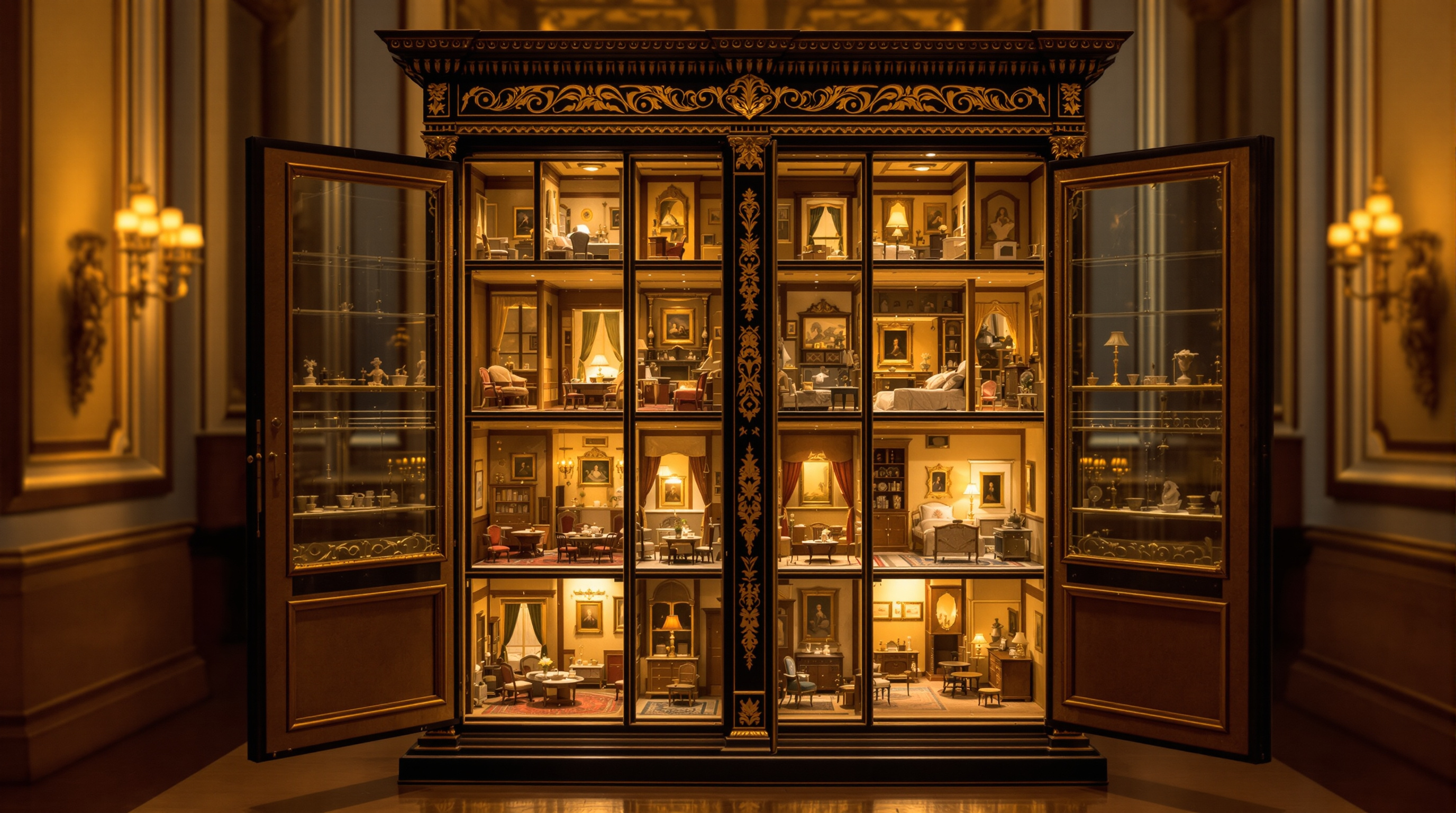
Since the earliest human cultures there have been depictions of daily life in miniature. The custom reaches far back — as far as the ancient pharaohs, whose grave goods included small figures and the utensils of everyday life. The wish to reproduce one's own reality in little is almost as old as civilisation itself.
From the beginnings to a collector's art
The history of the true dolls' house, however, is only about three hundred years old. The earliest finely made houses arose in Western Europe, where the prosperous middle classes and the nobility liked to surround themselves with beautiful things. What could be more natural than to repeat one's own carefully appointed world in miniature? These early pieces were by no means children's toys, but precious collector's objects and marks of status for grown-up enthusiasts.
The Dutch cabinet houses
Among the greatest lovers of the miniature were the Dutch of the seventeenth century, who began to fill magnificent cabinets with curious small things — whole houses hidden behind the doors of a fine piece of furniture. These cabinet houses rank among the most precious miniatures of their age; the celebrated dolls' house of Petronella Oortman in Amsterdam is said to have cost as much as a real canal house.
The Nuremberg houses
The oldest surviving true dolls' houses with complete inventory, by contrast, are found in Nuremberg. The city was a centre of the toy-maker's and fine-mechanic's craft, and its dolls' houses and miniature kitchens of the seventeenth and eighteenth centuries served both delight and instruction: at the "Nuremberg kitchen" young girls learned the running of a household. Many of these pieces may be seen today at the Germanisches Nationalmuseum.
A mirror of its time, and a golden age
For all who delight in the small images of reality and in the past, scarcely anything is as fascinating as a dolls' house, for it mirrors exactly the taste of an age — the way of dwelling, cooking and living, at the smallest scale. The richest flowering of this culture came in the nineteenth and early twentieth centuries, when industry produced miniature furniture in great variety and the dolls' house passed from the collector's cabinet into the nursery. Houses of the years 1850 to 1940 remain the heart of many collections to this day — including this one. To see how lost and damaged pieces become living small worlds again, read about the collection.